What Happened to the 13th Louisiana?
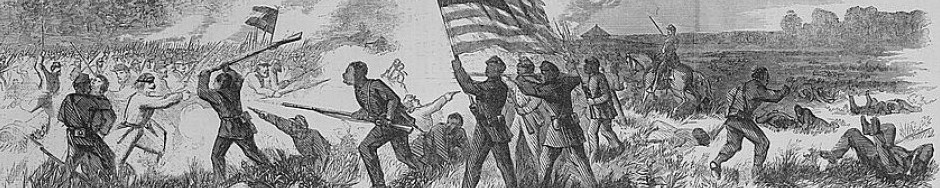
Nine regiments – five Union and four Confederate – are known to have participated in the battle of Milliken’s Bend. The Texas units were the 19th, 17th, and 16th Texas Infantry, and the 16th Texas Dismounted Cavalry. On the Union side, four of the five regiments were newly formed units belonging to the emerging United States Colored Troops. Assisted by the veteran 23rd Iowa Infantry, these units were the 11th Louisiana Infantry, African Descent; the 1st Mississippi Infantry, African Descent; the 13th Louisiana Infantry, African Descent; and the 9th Louisiana Infantry, African Descent.
With one exception, the history of these units is easily found. The Texas units went on to fight in the Red River Campaign of 1864 – the last major action they saw. The African Brigade, as the outfit that fought at Milliken’s Bend was known, were soon after reorganized. The 11th Louisiana became the 49th United States Colored Infantry. The 1st Mississippi became the 51st United States Colored Infantry, and the 9th Louisiana became the 5th United States Colored Heavy Artillery. All three of these went on to serve garrison duty at Vicksburg for most of the remainder of the war. The 51st USCI, though, was called away, and fought at Fort Blakely, Alabama in 1865.
The single exception, as mentioned above, is the 13th Louisiana Infantry, African Descent. The unit received no change of designation, as it was dissolved shortly after the battle in June 1863. The post return for that same month noted that “The 13th LA Infantry has no legal organization.” That same return lists a small number of officers as belonging to the regiment. August Goelzer is listed as “acting” Colonel, and Theodore Pleisch as Lieutenant Colonel. Two captains are also listed, Thomas McClellan and R.A. Strong. Fred D. Walker is listed as an Assistant Surgeon, and then several Lieutenants including Herman Knoll, Julius Knoll, Hunt Donning, Nathaniel Martin, and another Theodore Pleisch. It is possible this last entry is in error, accidentally listing the regiment’s Lieutenant Colonel under the lower rank of “Lieutenant.”
With such a complement of officers, why then, was the regiment disbanded after the battle? One of the first clues is also in the post return itself. Out of all the officers listed as belonging to the 13th Louisiana, only three were actually present: Herman Knoll, Julius Knoll, and Fred D. Walker. So far as can be determined, these three are the only ones that remained at the post of Milliken’s Bend. Colonel Augustus Goelzer, intended to hold that rank in the 13th Louisiana, seems to have delayed, or to have been delayed in taking that office. The reason for this is that the 60th Indiana’s existing Colonel, Richard Owen, resigned his commission on July 11, 1863. Military red tape being what it was (and is), word of the resignation was highly likely in the air already when Goelzer was preparing to take his new command. Instead, he was made Colonel of the 60th Indiana. Theodore Pleisch also retained the lower rank of Major under Goelzer, though he was not commissioned as such until nearly a year later. Records show that he was mustered out as a Captain in March 1865.
The remainder of the men who were intended to be officers also appear to have returned to the 60th Indiana Infantry. Fred D. Walker, rather than being an Assistant Surgeon, mustered out in 1865 with the rank of Quartermaster Sergeant. R.A. Strong and Thomas McLellan have not yet been identified. The remainder, however, belonged to the 60th Indiana. Julius Knoll held the rank of Corporal, whereas his brother Herman remained a Private. Both men were listed as 1st Lieutenants in the 13th Louisiana, and both served in Company G of the 60th Indiana. The man listed as “Hunt Donning” appears to be in reality Henry C. Downy or Downing of Company C.
The 13th Louisiana was reported to have 108 men present the day of the battle. Historian Edwin Bearss placed Herman Knoll as leading the 13th Louisiana. Given that he was one of three officers actually present that day, and listed above his brother, Julius, this seems to be accurate. Officers of other regiments, like Lieutenant Colonel Cyrus Sears of the 49th USCI, later denied that the 13th Louisiana had been there at all. Major David Cornwell of the 5th USCHA insisted just as vehemently that they were. The men of the 13th Louisiana are a much harder puzzle to solve. Since the regiment had such loose organization, there is no paper trail to follow, and so no reliable way to trace the men. The best estimate available is that they were dispersed among the other regiments stationed in the area at the time. To-date, none of them have been identified.
The three officers who led the regiment during the battle, however, are a different story. All of them were of foreign birth. Herman and Julius Knoll were brothers, born in Germany, and raised in Evansville, Indiana. Fred D. Walker was an Englishman, born on the southwest coast in Cornwall. As a teenager, he enlisted in the British Army but went absent without leave in 1859. In September of 1860 he arrived in New York City. In late 1861, he enlisted in the 60th Indiana Infantry, where, with the brief interruption in 1863, he remained until discharged in March 1865. In 1866, he enlisted again, this time in the 4th U.S. Artillery, where he served as a hospital steward. Discharged again in 1869, Walker returned to England, where he married one Lucretia Wharton. The newlyweds soon after moved to Australia, where he took up sheep farming. Walker made one last trip home to England, where he died in 1880, seemingly of heart failure.
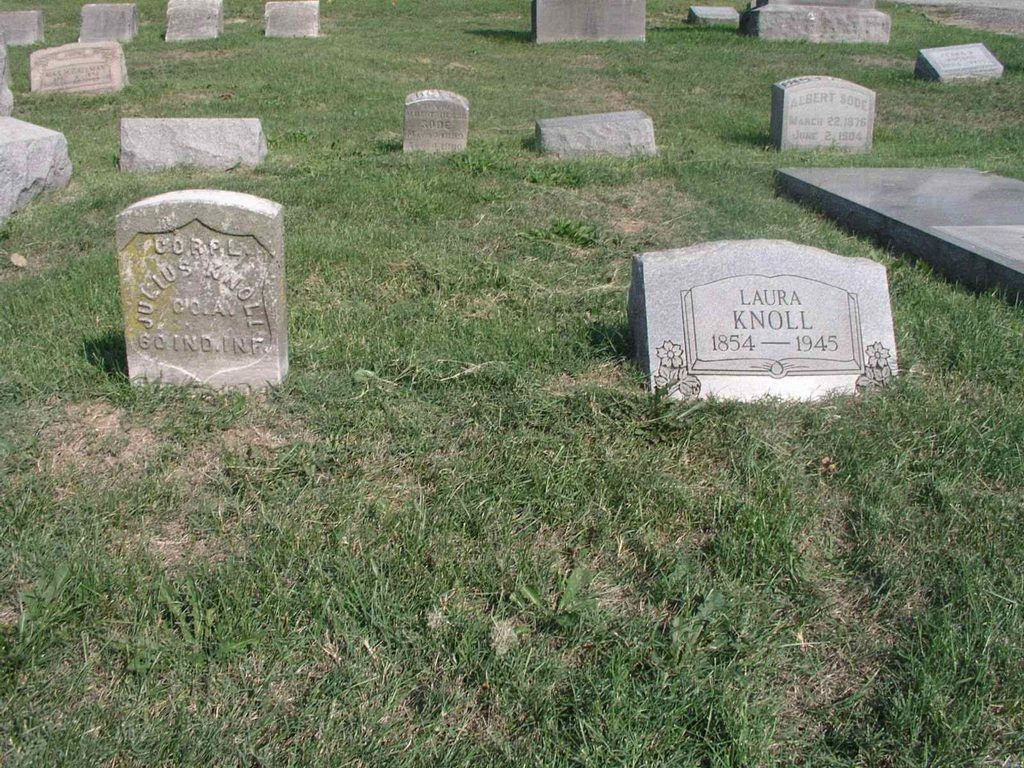
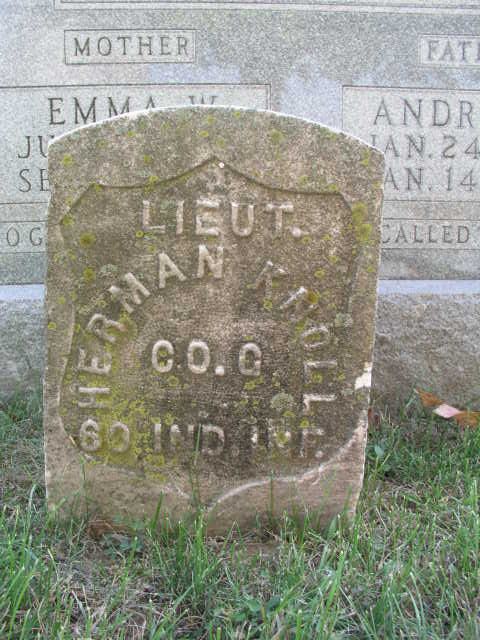
The Knoll brothers spent less time in the military than their English comrade. In 1860, Herman listed his birthplace as Berlin. Julius (actually Karl Julius), still living at home, gave his as Prussia. Herman worked as a wagon maker, and Julius as a laborer. The two enlisted in the 60th Indiana in late 1861. Julius, the younger by three years, mustered in on October 7. Herman mustered in just over a month later on November 15. Of the two, only Herman’s promotion to Lieutenant is listed. Julius is listed as having mustered out on March 21, 1865. The brothers returned to Evansville following the war. Herman remained there, while Julius, by 1880, moved to Wisconsin. Herman worked consistently as a wagon maker until at least 1900, while Julius plied his hand at various trades, from brick mason, to carpenter, to farmer. Julius, at some point before 1911, moved back to Evansville, where he died in January 1911. Herman outlived him by fourteen years. Both brothers lie in the same cemetery in Evansville, and both have military headstones marked for the 60th Indiana. Without looking further, no one would know that these men served as officers in an early USCT regiment, in one of the bloodiest small battles of the Civil War.
Comments
What Happened to the 13th Louisiana? — No Comments
HTML tags allowed in your comment: <a href="" title=""> <abbr title=""> <acronym title=""> <b> <blockquote cite=""> <cite> <code> <del datetime=""> <em> <i> <q cite=""> <s> <strike> <strong>