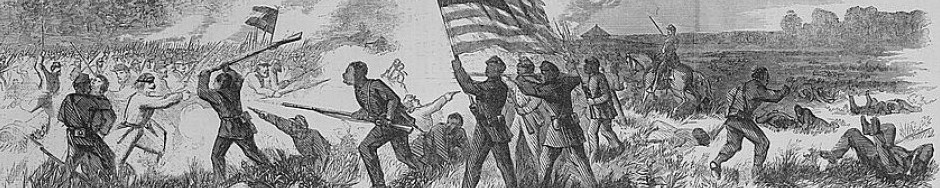
Fort Pillow and Milliken’s Bend
I recently had the opportunity to visit Fort Pillow State Park in Tennessee, about 2 hours north of Memphis. While there, I couldn’t help but bring the Milliken’s Bend story with me. To be sure, there are many important differences between the two battles:
- Time period: Milliken’s Bend occurred in the summer 1863, when the use of black soldiers by the North was still a new and evolving thing, for both sides. Fort Pillow occurred in April 1864, after black men had been in military service for over a year, after prisoner exchanges had already broken down, and after Confederate officials held fast to their plan that black men could not be recognized as soldiers, and thus, could not be treated like regular prisoners of war.
- Terrain: Milliken’s Bend was surrounded by the flat land of the Mississippi Delta. Fort Pillow was constructed on bluffs, on rugged terrain. Fort PIllow, as its name suggests, was a fortified location, strengthened by numerous breastworks. Originally built by the Confederate army in 1861, it had had additional construction and fortifications added. Milliken’s Bend was protected not by breastworks, but by two levees that ran parallel to the river.
- Attacking forces: At Milliken’s Bend, the assault was made by a Confederate infantry brigade, with minimal combat experience. At Fort Pillow, the attacking force was composed of Gen. Nathan Bedford Forrest’s Confederate cavalry, fierce fighters with plenty of combat experience.
Nevertheless, despite these differences, there are also noteworthy similarities. At both battles, the Union forces were on the defensive, taking positions behind breastworks or levees serving as breastworks. The bulk of the Union forces at both battles were composed of black men who had been former slaves. In both instances, the Confederate forces assaulted one Union line, compelled it to fall back to a second position, overwhelmed that position, in turn, and were very near to driving the Union troops in to the Mississippi River. Almost immediately after each battle, rumors and accusations were leveled at Confederate forces, claiming they had shot down men in cold blood, after they had surrendered.
After touring Fort Pillow, I am now more convinced than ever that if it had not been for the presence of the Union gunboats Choctaw and Lexington, a similar situation would have probably occurred at Miliken’s Bend. The gunboats halted the Confederates’ final advance. The Yankee soldiers at Miliken’s Bend were moments from annihilation on the river bank. At Fort Pillow, the New Era had come under fire early in the battle, making it difficult for the gunners to man their pieces. As a result, they closed their gunports, and did not provide supporting fire for the Fort Pillow garrison. Overwhelmed and overrun at their second position, much of the garrison was forced to the riverbank, where they had no where else to go. It was on this landing, gathered en masse and hotly pursued by Forrest’s men, that many black Union soldiers were killed. Whether or not this was a true massacre is debated to this day, with many scholars supporting the reports of Union officers who claimed men were shot down mercilessly, even after they threw down their weapons. Others see the events as men in battle pursing their enemy relentlessly, which is the nature of war. Forrest had already given the garrison an opportunity to surrender, earlier.
There is too much debate and too much detail to be examined to make a brief assessment here about what happened at Fort Pillow. But I was struck by the similarities of the nature of the fighting – with the Union forces being overwhelmed both at Milliken’s Bend and at Fort Pillow – and the important role that gunboats played at both locations in the final moments of the fighting. At Milliken’s Bend, the fire from two gunboats halted the Confederate attack, just as they approached the riverbank. At Fort Pillow, the inaction of the New Era allowed the Confederate troopers to relentlessly pursue their enemy and drive them in to the river, inflicting many casualties.
In addition, I can encourage individuals interested in Miliken’s Bend to visit the Fort Pillow site. Milliken’s Bend washed away decades ago, so there is no historic landscape or battlefield to see. At Fort Pillow, although overgrown, most of the earthworks are still there, albeit at the end of a long and steep hike. The old river channels are still there as well, and by walking the ground, a visitor can gain a good sense of the unfolding of the battle, from one position to another.
Comments
Fort Pillow and Milliken’s Bend — No Comments
HTML tags allowed in your comment: <a href="" title=""> <abbr title=""> <acronym title=""> <b> <blockquote cite=""> <cite> <code> <del datetime=""> <em> <i> <q cite=""> <s> <strike> <strong>