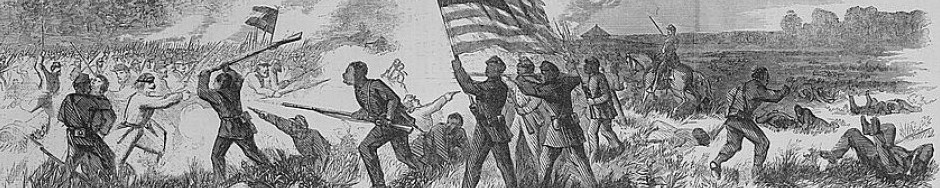
1st Arkansas in the Milliken’s Bend story
Although not present at the battle of Milliken’s Bend on June 7, 1863, the story of the 1st Arkansas Infantry, African Descent (later renamed the 46th U.S. Colored Infantry or USCI) nevertheless is essential in the larger narrative of events in Northeastern Louisiana that summer.
On June 29, 1863, two companies of the 1st Arkansas Infantry, A.D. were posted atop a large Indian mound, not far from Goodrich’s Landing, Louisiana, about 10 miles or so north of Milliken’s Bend. This regiment was organized near Helena, Arkansas in late April and early May, and most of the enlisted men were former slaves from plantations in the Mississippi River bottomlands. These men had not been in the military for even two months when Confederate troops from Col. William H. Parsons cavalry brigade showed up in force at their outpost. Consisting of two regiments and an artillery battery, subsequently reinforced by Confederate Brig. Gen. James C. Tappan’s infantry brigade, the Union infantrymen were hopelessly outnumbered, and given the terrain, likely surrounded as well. They had little choice but to surrender.
Some sources state that Col. Parsons issued orders that no Black men should be taken prisoner, but apparently the sheer numbers of captured Union men made implementing this order impossible. Maj. Gen. John G. Walker (CSA) apologized to his superior, “that any armed negroes were captured,” but felt that there was no other alternative. Confederate accounts state that 113 Black soldiers were captured. Federal sources give that number as 128. Some eyewitness accounts from Black soldiers state that as many as a dozen men may have been shot down not long after their capture, and this could explain the discrepancy in the two figures. Many records for the 1st Arkansas were lost or destroyed, so determining what actually happened, how many men were captured, how many survived their time in Confederate hands, and how many died as a result of their treatment, imprisonment, or return to enslavement remains unclear.
The events at The Mound are important because it shows that by and large, Confederates took these men prisoner, and evacuated them to the west. First, to the railhead at Delhi, then to Monroe, and likely, eventually, to Shreveport or even Texas. The four white officers captured at the Mound were held as prisoners “in close confinement” at Monroe, and most were freed in August during Brig. Gen. John D. Stevenson’s brief expedition to the town.
The day after The Mound, the Mississippi Marine Brigade (USA) disembarked and scouted the countryside. They found slave cabins and cotton gins set aflame by Parsons’ raiding cavalrymen, and some exaggerated claims would state that burned corpses and even crucified remains were linked to fighting near Milliken’s Bend or the Mound.
Determining precisely what happened in the immediate aftermath of the Mound is difficult, and it is possible that some men may have been executed or shot down as the Confederates withdrew. But knowing that most of the men survived long enough to be taken prisoner and sent west leaves several open questions: After they were evacuated, what happened to them? Were they re-enslaved, put to labor on Confederate fortifications or other hard labor tasks? Were some of these men sold in to slavery, in to private hands of planters or industrialists? Were some perhaps imprisoned in county jails or prison or labor camps? How many men remained in Shreveport, and how many were sent elsewhere? So many questions remain.
But a key finding, that also may have implications for the Black soldiers captured at Milliken’s Bend, is that the majority of the men at the Mound were not executed. This gives us hope that more of their story can be discovered and shared.
Sources: Milliken’s Bend: A Civil War Battle in History and Memory by Linda Barnickel, pp. 122-128; War of the Rebellion: the Official Records….. series 1, vol. 24, part 2, pp. 466; Black Flag Over Dixie by Gregory J.W. Urwin, p. 141; Like Men of War by Noah Andre Trudeau, pp101-102.
Comments
1st Arkansas in the Milliken’s Bend story — No Comments
HTML tags allowed in your comment: <a href="" title=""> <abbr title=""> <acronym title=""> <b> <blockquote cite=""> <cite> <code> <del datetime=""> <em> <i> <q cite=""> <s> <strike> <strong>